The Method
The starting pointThe Ten Commandments are usually read as moral instructions. This page reads them differently — as operational constraints derived from the mechanics of the Tree of Life.
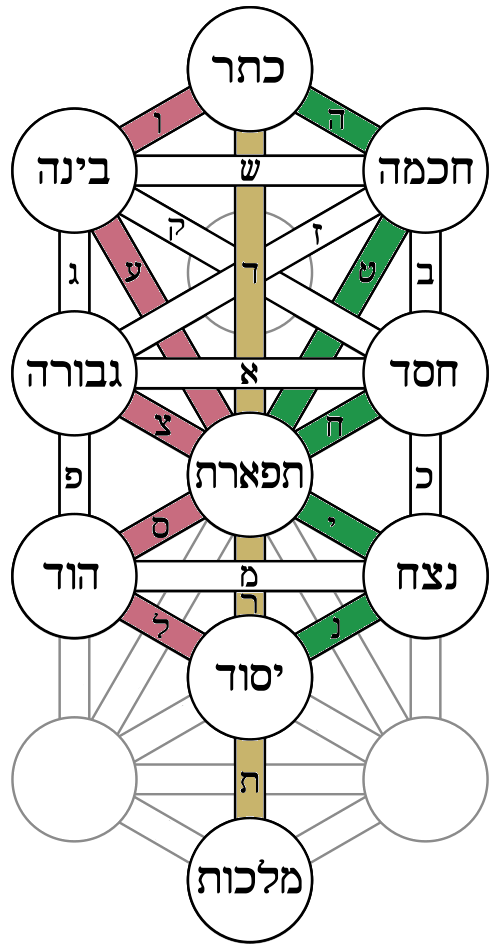
Each path on the Tree connects two sefirot and is assigned a Hebrew letter. The letter carries a traditional functional meaning. The sefirot carry traditional properties. From those three inputs — letter, upper node, lower node — a path function emerges. The commandment associated with that path then reads as the maintenance rule for that function. If you maintain the function, the path operates correctly. If you violate the commandment, you are describing the exact failure mode of that path.
This is not symbolic interpretation applied afterward. The commandment appears as a consequence of the architecture.
A useful analogy: a circuitry diagram, a machine's code, and its operating manual describe the same machine from different levels of abstraction. Of course they match — they were always describing the same system. The Tree describes the network. The letters describe the operators running on it. The commandments describe the constraints required to keep those operators functioning.
The Two Tablets
Two architecturesThe Ten Commandments split into two tablets of five. The right tablet establishes order from the top down — the architecture of alignment, the conditions under which the Creator's light can safely descend into the world. The left tablet maps how order decomposes — the architecture of restriction and failure, tracing how corruption propagates upward from distorted desire toward the severing of life itself.
The paths themselves are neutral conduits. The question is never whether energy flows through them. The question is whether the flow is aligned or distorted.
What makes the structure striking is that the two tablets are not two separate lists. They are five principles, each with two faces — one aligned, one corrupted — operating on the same channel from opposite directions. Read that way, the commandments are not ten rules. They are five descriptions of what can go right, and five descriptions of what goes wrong when it does.
Both tablets converge at תפארת — the heart. Everything either enters harmony through the heart or becomes distorted before reaching it. The heart is the causal regulator of the whole system.
The Five Principles
Each principle has two faces — one aligned, one corrupted — operating on the same channel
The five principles carry load-bearing dependencies. The first establishes the only object of desire that cannot exhaust itself — without it, the three that follow have no direction. Principles two, three, and four form an inner triad: what enters the heart, what the hand does with what it holds, what the mouth testifies to. Each depends on the one before. The fifth places the soul in relation to everything outside itself — the ecology of where it came from and where it is going.
One principle to establish the guidepost. Three to order the inner world. One to situate you correctly in the world you move through. The inner three collapse without the first. The whole structure drifts without the fifth.
The right face opens the window toward the only object of desire that cannot be possessed. The left face — murder — tears out the peg that holds a life to that same source. One establishes the orientation. The other severs it permanently in another. Same channel, opposite movements.
Chet establishes the fence. Ayin is what looks over the fence. The healthy sequence: wisdom → boundary → relationship. The distorted sequence: observation → desire → violation of the boundary.
Both faces ask the same question: what do you do with what has been entrusted to you? Tet is stewardship of spiritual authority. Tzadi is stewardship of material boundary. The failure mode in both cases is mishandling something given — one by misuse of power, one by appropriation of what belongs elsewhere.
Yod testifies to reality through action. Samekh protects the circuit through which reality is communicated in speech. One creates a true narrative through what it does. The other destroys the channel that makes truthful communication possible. This is the strongest structural mirror in the whole system.
Nun asks: what has been given to me? Lamed distorted asks: what belongs to someone else? Honoring lineage acknowledges inheritance — I stand in a chain. Coveting rejects it — I compare myself against another chain. This is the deepest psychological pair. It reaches the root of identity itself.
תפארת — The Regulator
The center holds — or it doesn't
Nearly every path in both tablets converges at תפארת. From the right: filtered wisdom arrives from חכמה, coiled energy descends from חסד, and the heart seeds its balance downward into נצח. From the left: Ayin pierces it with external desire, Tzadi hooks גבורה toward it, and Samekh must insulate the feedback loop running away from it into הוד.
תפארת is the causal regulator of the entire system. Everything either enters harmony through it or becomes distorted before reaching it. This is not a metaphor for where morality is evaluated. It is the literal node at which the soul's alignment — or its failure — is determined. If the heart holds, the path upward is open. If the heart is compromised, the gates above are compromised before the soul even reaches them.
This is why the ascent begins at תפארת.
The Three Gates — The Ascent
The third architecture
Between the right and left pillars stands the middle. It belongs to neither tablet. It is the path the soul walks deliberately — upward, from the physical Kingdom through the Foundation and the Heart, all the way to the Crown. Three gates mark the crossing. Each one opens only from within.
The soul begins in מלכות — the world of physical action, where everything has already materialized. One path leads upward. It opens with a mark. The mark is not earned; it arrives. It is the moment when no external acquisition reaches the hunger that remains. The world's goods have been fully tried. None of them fill the place that is still empty. That emptiness is the signal. The Foundation is now accessible.
Whether the Foundation can hold the mark depends on what has pooled there. The right tablet's fifth path has been feeding יסוד from above — Nun submerging inherited drive into deep waters, keeping the pool clean. The left tablet's tenth path attacks the same crossing from below — Lamed's distorted steering poisoning the Foundation with envy of what belongs to another. If the pool is clean, the mark initiates a real ascent. If the pool is corrupted, the soul receives the signal and cannot hold it.
Resh is the head of a river — not the intellect, but the source. To pass this gate is to trace the waters back to where they begin. Everything that has pooled in יסוד — drives, inherited patterns, unnamed yearnings, the accumulated weight of what has not yet found its name — rises now to meet the heart. The ascent from Foundation to תפארת is the movement of bringing what is subconscious into the light of conscious experience. The beginning of real inner work.
תפארת receives from both tablets simultaneously. The soul that has maintained the right tablet's architecture — the window open, the fence intact, the coil functioning, the seed planted — arrives at the heart with its channels clear. The soul that has allowed the left tablet's failure modes — the eye wandering, the fishhook projecting, the insulation punctured — finds the heart already compromised before the crossing begins. The two tablets are not background context. They are the condition of the heart that greets the ascending soul.
Dalet is a door. It stands between the purified heart and the unknowable Crown. Its handle is on the inside. The door does not open through understanding — it opens through השתוות הצורה, equivalence of form. The soul that has turned its intention, that has made the quality of giving its own rather than merely admiring it, finds the door already open. The alignment is the key. Not the knowledge of alignment. The actual turning.
The highest corruption on the left tablet — murder — operates on the same path as the highest alignment on the right: both touch כתר. The first commandment opens a window in the Source. The sixth commandment describes the destruction of the hook that fastens a life to that same Source. The soul that arrives at this final gate carries the full record of the two tablets with it. Every operator maintained, every failure mode encountered and navigated. The door reads all of it.
The Ten Commandments are not moral rules. They are maintenance protocols for the soul's operating system — the constraints required to keep each path's operator functional. Maintain the right tablet and the channels of alignment stay open. Allow the left tablet's failure modes and the architecture degrades, sometimes irreversibly.
The three gates are not a reward for good behavior. They are what becomes structurally possible when the architecture holds. The preparation is the work. The ascent is what the work makes possible.
The window is either open or it isn't.
The Foundation is either clean or it isn't.
The door knows the difference.